Thursday, October 1, 2026






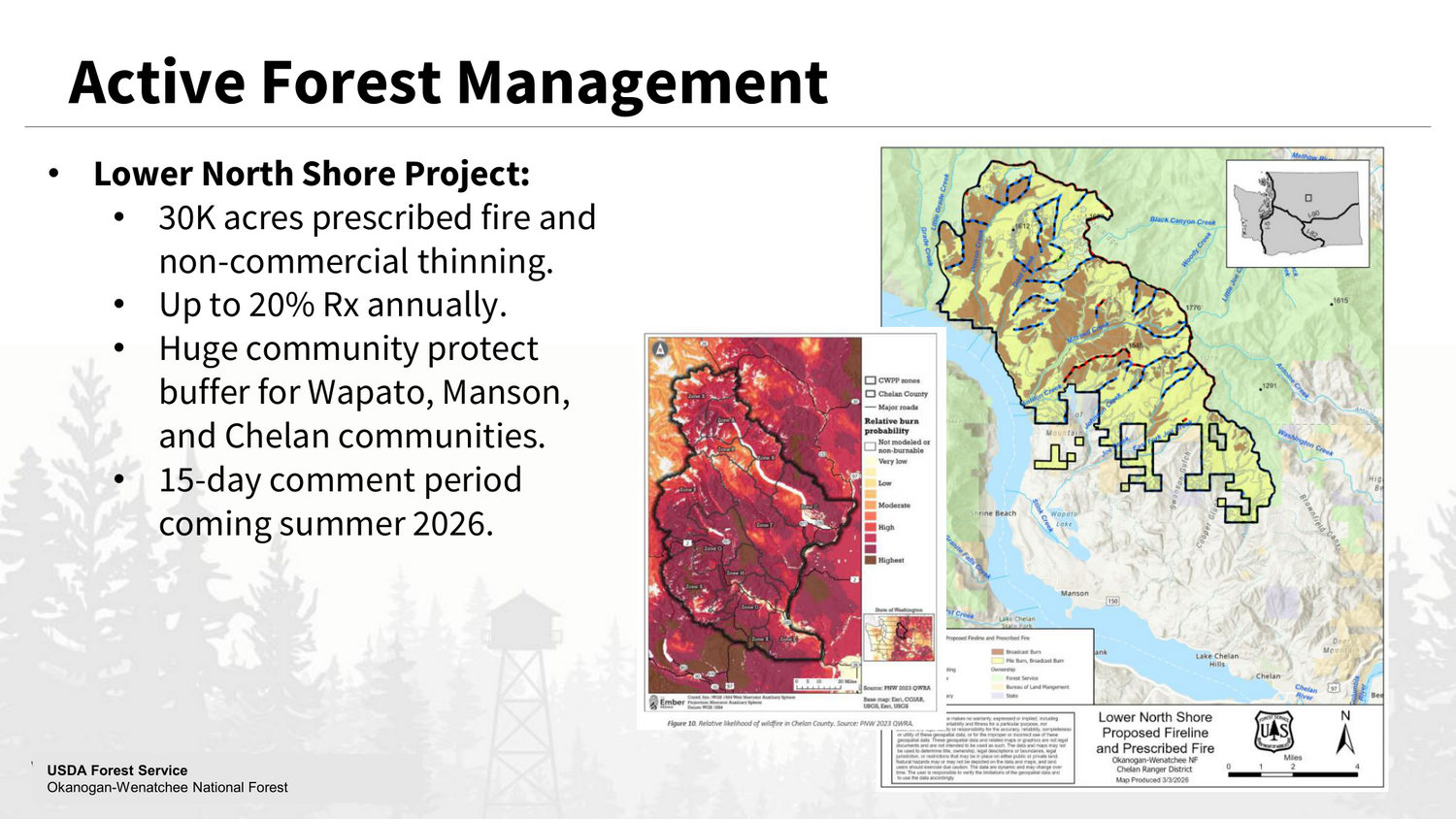
CHELAN — A proposed 30,000-acre forest restoration project above Lake Chelan could create a major wildfire buffer for the communities of Chelan, Manson and Wapato Lake, according to an update presented June 9 by U.S. Forest Service District Ranger Holly Craig.
Craig outlined the proposed Lower North Shore Project during a presentation to the Chelan City Council, describing it as a long-term effort to reduce wildfire risk through prescribed burning and forest thinning across thousands of acres on the north shore of Lake Chelan.
The project would encompass approximately 30,000 acres and combine prescribed fire with non-commercial thinning treatments intended to reduce fuel loads and restore more resilient forest conditions.
"The reason why this matters so much is that for any future wildfires that would come down lake, this creates an incredible buffer," Craig told council members. "A 30,000-acre buffer that firefighters could actively go in and more safely catch and stop that future wildfire from impacting incredibly valuable orchards, other community properties and, of course, homes as well."
According to Craig, the treatment area was selected in part because wildfire risk modeling shows the Chelan-Manson-Wapato corridor among the most vulnerable areas in Chelan County.
Maps presented to the council illustrated how fuel reduction work could substantially reduce potential flame lengths during a wildfire. Craig said areas currently modeled for flame lengths exceeding 25 feet could, after treatment, be reduced largely to one- to four-foot flame lengths, improving both firefighter safety and the likelihood of successful suppression efforts.
The project would be implemented over many years rather than all at once. Craig said no more than about 20 percent of the project area would be treated in any given year, balancing available resources with concerns about smoke impacts and operational capacity.
A public comment period on the proposal is expected later this summer.
The Lower North Shore Project follows other recent fuel-reduction work in the area. Craig reported that Forest Service crews completed approximately 467 acres of prescribed burning this spring, including a cross-boundary project on Bear Mountain conducted in partnership with The Nature Conservancy and the Chelan-Douglas Land Trust.
Craig's presentation came as wildfire officials continue monitoring conditions heading into summer.
While low snowpack has prompted concern across the region, Craig said snowpack alone is not a reliable indicator of how severe a fire season may become.
"Low snowpack equals an earlier fire season, not necessarily an intense fire season," she said.
Current conditions suggest fire season is running roughly three to five weeks ahead of normal. May brought warmer-than-average temperatures and below-average precipitation, and similar conditions are forecast for the coming months.
Craig said long-range indicators currently resemble a combination of 2005 snowpack conditions and weather patterns seen in 2015, a year remembered throughout North Central Washington for major wildfires including the Wolverine Fire.
Still, she emphasized that summer lightning activity, temperatures and rainfall will ultimately determine how active the season becomes.
The Forest Service currently has significant firefighting resources positioned throughout the region, including rappellers, smokejumpers, hotshot crews, helicopters and engines. However, Craig noted that during major fire years, resource availability can become a challenge as crews and aircraft are committed to incidents across the western United States.
"If we don't get storms, it really doesn't matter how dry it is," Craig said. "Or if we get those lightning busts that come across and they come with wetting rains, we're also probably going to mostly be okay."
She said the proposed Lower North Shore Project is intended to improve the region's ability to withstand whatever future fire seasons may bring.
"We're really excited about being able to bring this online to help better protect this area," Craig said.
Andrew Simpson: 509-433-7626 or andrew@ward.media


Comments
No comments on this item Please log in to comment by clicking here